Oral Presentation Crystal36-AXAA Conference 2026
High-pressure X-ray diffraction on pillared metal-organic frameworks (142712)
Establishing fundamental structure-property relationships is foundational to the design of functional materials. Flexible metal-organic frameworks (MOFs) provide an ideal platform for investigating these relationships, as the ability to vary individual components within the MOF architecture allows targeted changes to the framework while preserving an otherwise analogous structure.1,2 High-pressure diffraction provides a powerful means of probing mechanical properties such as framework compressibility, structural transitions, and mechanical stability through analysing changes in lattice parameters and the determination of bulk moduli. While high-pressure single-crystal X-ray diffraction (HP-SCXRD) remains the benchmark for resolving detailed atomic changes,3 its application is often limited by crystal size and diffraction quality inherent in certain MOF systems. Thus, it restricts the range of materials that can be investigated.
High-pressure powder diffraction (HP-PD) offers an attractive alternative to single-crystal studies; however, performing HP-PD on MOFs is not trivial. Here, we explore the use of the MX1 beamline at the Australian Synchrotron for HP-PD and compare its performance with high-pressure diffraction measurements collected using Wombat at the Australian Centre for Neutron Scattering.4 This work uses an isoreticular series of pillared-layer frameworks: Ni(bdc)(dabco)₀.₅, Ni(pdc)(dabco)₀.₅ and Ni(bodc)(dabco)₀.₅, incorporating the dicarboxylate linkers benzene-1,4-dicarboxylate (bdc), bicyclo[1.1.1]pentane-1,3-dicarboxylate (pdc) and bicyclo[2.2.2]octane-1,4-dicarboxylate (bodc) with the common pillar 1,4-diazabicyclo[2.2.2]octane (dabco). Through the systematic variation from aromatic (sp²) to bulky aliphatic (sp³) linker, we investigate the influence of linker chemistry on framework compressibility and bulk modulus. Importantly, this work represents the first systematic investigation of the mechanical response of MOFs spanning aromatic and aliphatic linkers under pressure. It will also establish the first HP-PD methodology on the MX1 beamline at the Australian Synchrotron – a step that opens new opportunities for high-pressure research in the Australian crystallographic community. The outcomes of this work will not only provide critical insights into the fundamental design rules governing the mechanical resilience in MOFs but also provide a methodological foundation for future high-pressure studies.
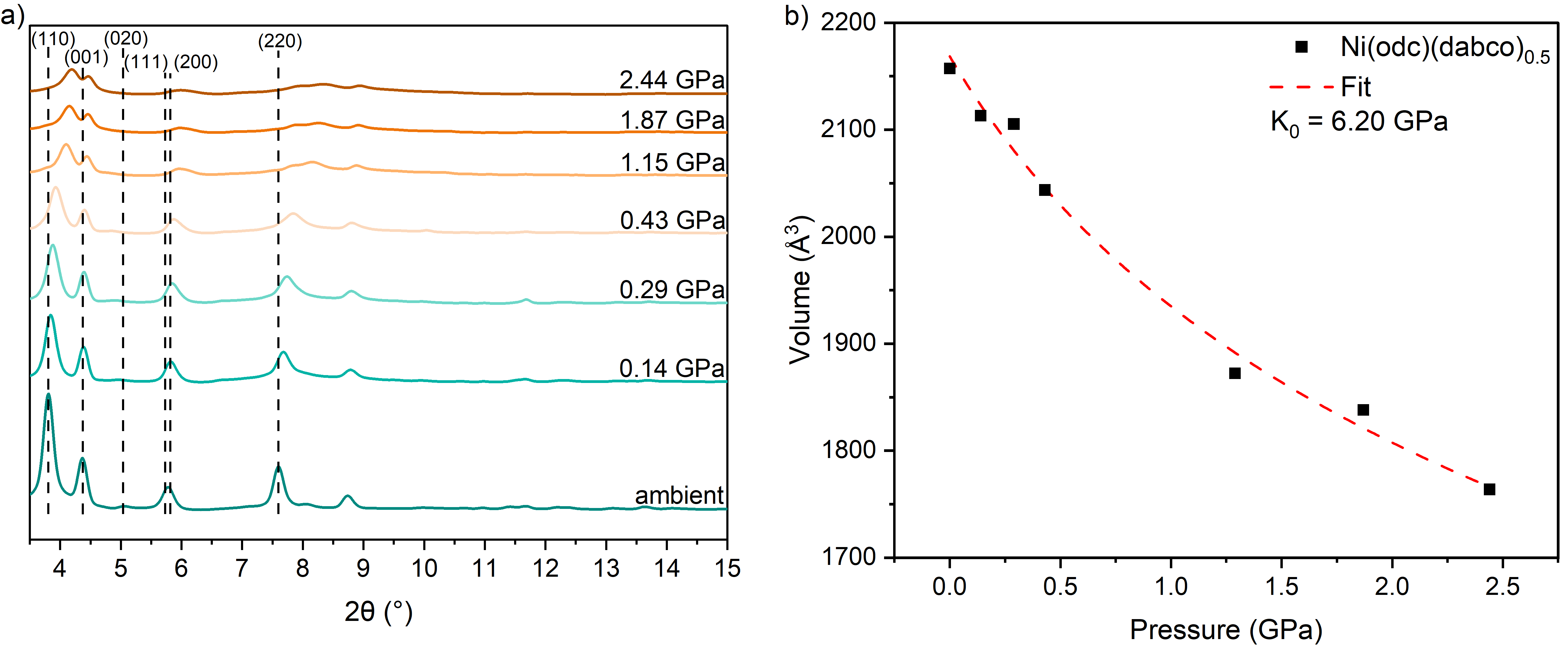
Figure 1. The powder pattern of Ni(odc)(dabco)0.5 in silicon oil from 0 – 2.44 GPa, collected from the MX1 beamline, Australian Synchrotron (a). The third order Birch–Murnaghan fit for Ni(odc)(dabco)0.5 using unit cell parameters exacted from the powder pattern (b).
- (1) Jiao, L.; Seow, J. Y. R.; Skinner, W. S.; Wang, Z. U.; Jiang, H.-L. Metal–Organic Frameworks: Structures and Functional Applications. Mater. Today 2019, 27, 43–68. https://doi.org/10.1016/j.mattod.2018.10.038.
- (2) Lee, J. H.; Jeoung, S.; Chung, Y. G.; Moon, H. R. Elucidation of Flexible Metal-Organic Frameworks: Research Progresses and Recent Developments. Coord. Chem. Rev. 2019, 389, 161–188. https://doi.org/10.1016/j.ccr.2019.03.008.
- (3) Understanding the adsorption process in ZIF-8 using high pressure crystallography and computational modelling | Nature Communications. https://www.nature.com/articles/s41467-018-03878-6 (accessed 2026-07-07).
- (4) Maynard-Casely, H. E.; Tobin, S. M.; Wang, C.-W.; Peterson, V. K.; Hester, J. R.; Studer, A. J. Wombat, the High-Intensity Diffractometer in Operation at the Australian Centre for Neutron Scattering. J. Appl. Crystallogr. 2026, 59 (1), 1–11. https://doi.org/10.1107/S1600576725010337.