Oral Presentation Crystal36-AXAA Conference 2026
Mechanisms of negative thermal expansion in empty NaSICON-type phosphates (142865)
NaSICON-type phosphates M’M”(PO4)3 (M = transition metal) with a 3D framework made of corner-sharing MO6 octahedra and PO4 tetrahedra are of interest due to their reported anomalous thermal expansion which can have applications in material science such as thermomechanical stability and increased resistance to thermal shock. The selection of appropriate M influences the coefficient of thermal expansion (CTE), which may be tailored for use from negative to near-zero to positive. We have studied temperature-driven evolution of crystal structure by variable temperature neutron powder diffraction and X-ray powder diffraction in a wide temperature range of ~3-1200 K. We suggest that in the high-symmetry R-3c form the negative thermal expansion is driven by increasing transversal displacement of oxygen atoms bridging M and P atoms, while in the low-symmetry R-3 form the thermal expansion drastically changes to positive, driven by polyhedra tilting. Ab initio molecular dynamics (AIMD) simulations supported this picture and provided additional insights.
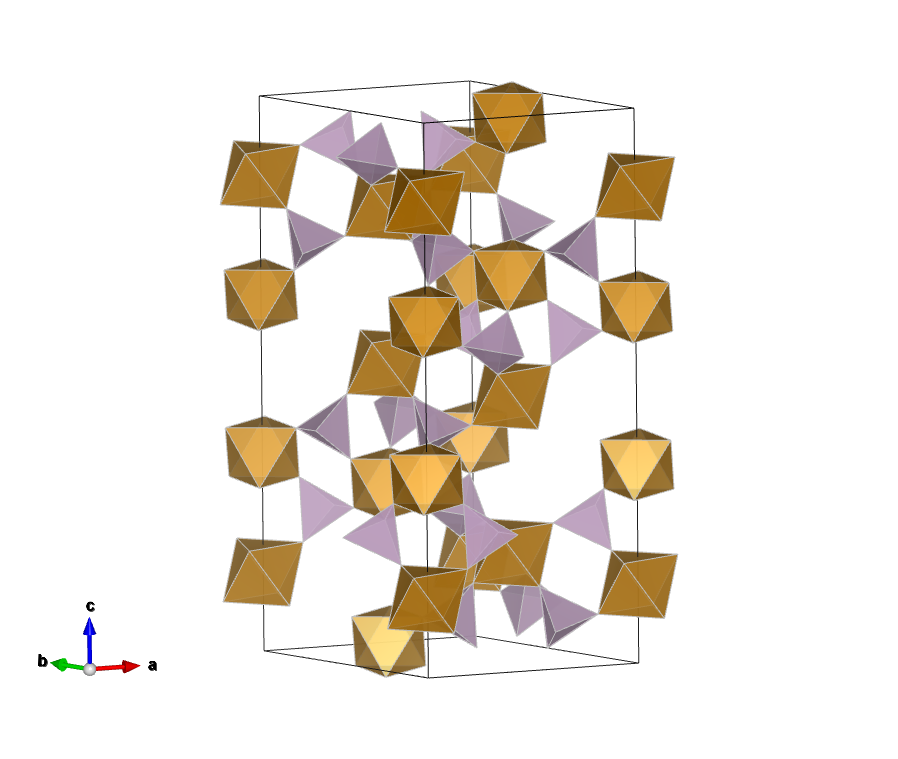

Figure 1: (Left) NaSICON crystal structure, MO6 octahedra in orange, PO4 tetrahedra in purple; (right) Normalised unit cell volume of M’M’’(PO4)3 vs. temperature. Filled data points are NPD, empty are XRD, and crossed are AIMD.