Poster Presentation Crystal36-AXAA Conference 2026
Structural Phase Behaviour of Caesium Periodate, CsIO4: Complementary X-ray and Neutron Powder Diffraction Investigation (143117)
Caesium periodate, CsIO4, is a scheelite-related oxide that crystallises in the orthorhombic Pnma pseudo-scheelite structure at room temperature. Upon heating, X-ray powder diffraction suggests that the a and b lattice parameters become equal, causing the XRD pattern to appear tetragonal and consistent with the I41/a space group. However, the scattering in X-ray diffraction is dominated by the heavy caesium and iodine atoms, resulting in reduced sensitivity to the oxygen sublattice. Neutron powder diffraction was therefore employed to resolve this limitation. WOMBAT, the high-intensity powder diffractometer at the Australian Centre for Neutron Scattering, was used to investigate the crystal structure at elevated temperatures. These measurements demonstrate that the Pnma structure is retained across the entire temperature range examined (50–500 K). Rietveld refinements on these diffraction patterns show that the difference between the a and b lattice parameters decreases continuously with increasing temperature but does not vanish, indicating that the apparent transition is a metric effect arising from the thermal contraction of the CsO8 polyhedral rather than an actual change in space group symmetry. Furthermore, polyhedral analysis supports this interpretation: the distortion indices of the CsO8 and IO4 polyhedral decrease upon heating, while the oxygen atoms become increasingly disordered as the structure approaches its stability limit.
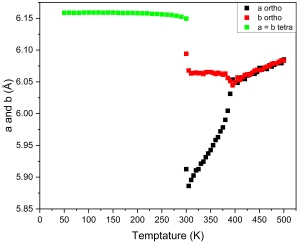
Figure 1. Temperature evolution of the a and b lattice parameters of CsIO4 from variable-temperature neutron powder diffraction (WOMBAT). CsIO4 is tetragonal (a = b, green) below 300 K and undergoes a tetragonal to orthorhombic (Pnma) transition at the same temperature, marked by the splitting of a (black) and b (red), which persists to 500 K.