Poster Presentation Crystal36-AXAA Conference 2026
Aromatic cis-capping ligands reconfigure a cage system for remote controlled anion-mediated BODIPY uptake and release (143187)
Water soluble coordination cages that obey the formula (Pd-LC)6L4 (Lc = capping ligand, L = panelling ligand) are archetypal host structures exhibiting strong and selective molecular recognition with association constants reaching up to Ka ≥10⁸ M⁻¹, approaching the affinities of biological receptors.1,2 In contrast to natural systems, the controlled uptake or dissociation of bound guests in (Pd-LC)6L4 cages is more challenging to achieve due to the hydrophobic effect. Typically, guest dissociation is only attained via an unregulated “turn off” mechanism via a stimuli-responsive guest,3 competitive guest binding4 or through extraction5. Biological systems such as Haemoglobin are able to reversibly achieve high-affinity molecular recognition and regulate guest dissociation by undergoing a topological change due to a distantly bound effector molecule.6 Synthetically replicating this strategy is extremely rare and challenging.7
Here we show that controlled guest uptake and release can be achieved by exploiting a dynamic cage isomer equilibrium that exhibits reciprocal allostery. First, we replaced the flexible diamine capping ligand of a (Pd-LC)6TimB4 cage (TimB = 1,3,5-tri(1H-imidazol-1-yl)benzene) with aromatic 2,2′-bipyridine (bpy) and 1,10-phenanthroline, which reversed the isomer preference, with the previously favoured tube host present at 15% at equilibrium.8 The dynamic equilibrium of the (Pd-LC)6TimB4 cage can be applied to cooperatively regulate the uptake and release of pentamethyl BODIPY with a concomitant emissive response controlled through an exohedrally binding effector anion. The ability to control dynamic equilibriums through peripheral ligands and effector anions, without cavity filling is of considerable interest for developing synthetic biomimetic host–guest catch-and-release systems. This could see potential applications as an aqueous topologically responsive system within bioimaging, catalysis, sensing and guest-stabilisation.
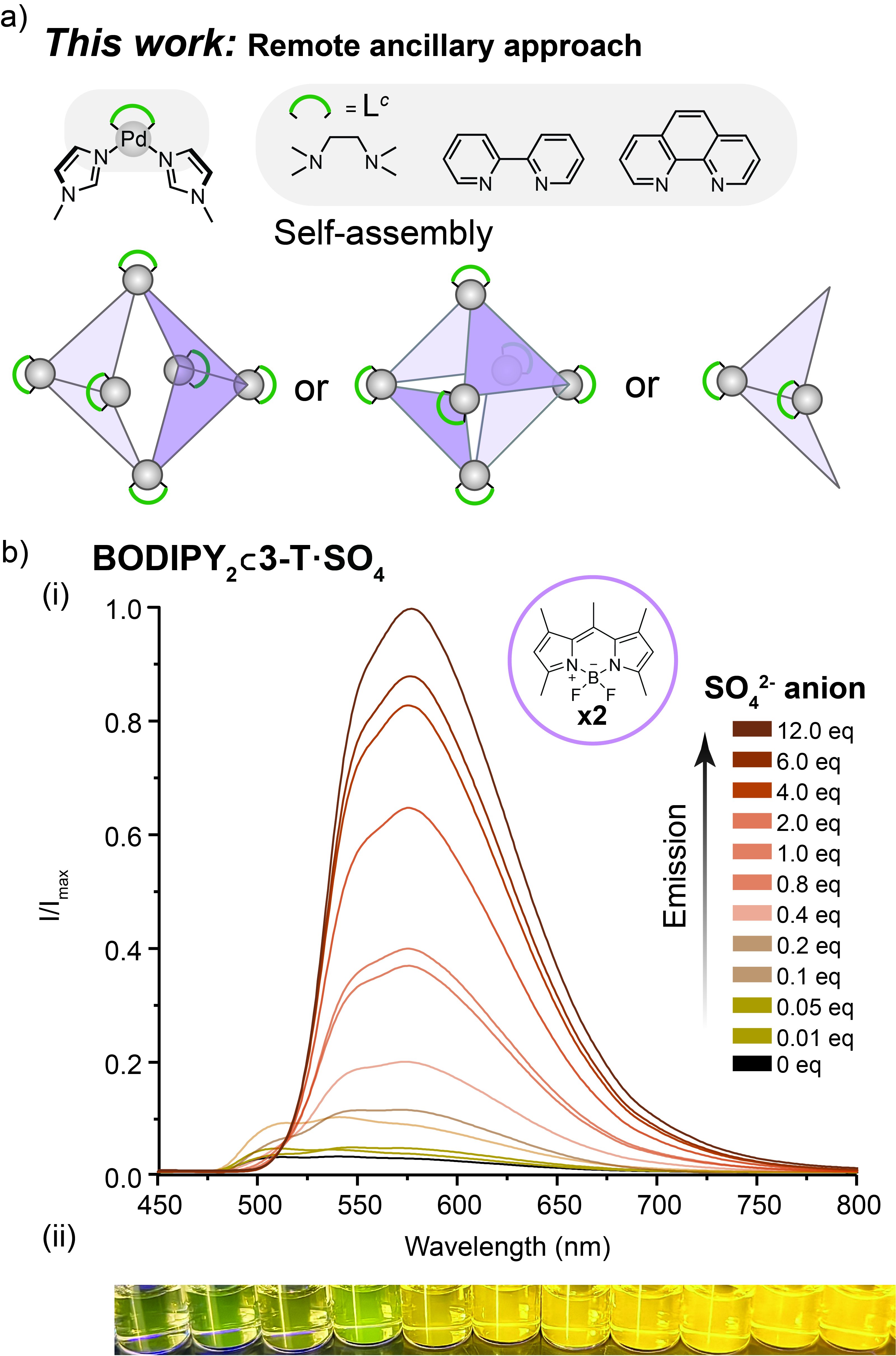
Figure 1. a) The remote ancillary approach determines the major topological isomer in equilibrium, b) this equilibrium can be exploited via the exohedral binding of an effector anion to regulate BODIPY emission.
- Houk, K. N.; Leach, A. G.; Kim, S. P.; Zhang, X., Angew. Chem. Int. Ed., 2003, 42 (40), 4872–4897.
- Percástegui, E. G.; Ronson, T. K.; Nitschke, J. R., Chem. Rev., 2020, 120 (24), 13480–13544.
- Banerjee, R.; Bhandari, P.; Hickey, N.; Mukherjee, P. S., J. Am. Chem. Soc., 2025, 147 (26), 23049–23059.
- Hema, K.; Grommet, A. B.; Białek, M. J.; Wang, J.; Schneider, L.; Drechsler, C.; Yanshyna, O.; Diskin-Posner, Y.; Clever, G. H.; Klajn, R., J. Am. Chem. Soc., 2023, 145 (45), 24755–24764.
- Genov, G. R.; Takezawa, H.; Hayakawa, H.; Fujita, M., J. Am. Chem. Soc., 2023, 145 (31), 17013–17017.
- Yang, Y.; Du, Y.; Heard, A. W.; Nitschke, J. R., Nature Synthesis, 2025, 4, pp 537–551.
- Kim, T. Y.; Vasdev, R. A. S.; Preston, D.; Crowley, J. D., Chemistry - A European Journal 2018, 24 (56), 14878–14890.
- Samanta, D.; Mukherjee, S.; Patil, Y. P.; Mukherjee, P. S., Chemistry - A European Journal, 2012, 18 (39), 12322–12329.