Poster Presentation Crystal36-AXAA Conference 2026
Quasi spin crossover metalloligands as building blocks to engender magnetism in extended architectures (143428)
Spin crossover (SCO) materials have attracted significant interest as promising candidates for future nanodevices owing to their intrinsic magnetic and electronic bistability and ‘switchability’. However, challenges remain in preserving SCO behaviours between the parent molecular building blocks and the product (and typically more sophisticated) architectures.1 This phenomenon occurs in transition metal ions of 3d4-7 electron configuration such that a transition between the low-spin (LS) and high-spin (HS) states is possible resulting from some form of environmental stimulus. More often, this spin-state switching is observed for transition metal complexes bearing Fe(II) metal ions due to the greater difference in structural and electronic signatures between the LS (S = 0, t2g6eg0) and HS (S = 2, t2g4eg2) states, rendering identification of each spin-state in Fe(II)-containing systems by X-ray diffraction a relatively straightforward process. We now present the metalloligand approach as a general strategy to enable the transfer of SCO or ‘quasi’-SCO behaviours occurring in the parent metalloligand building blocks into an extended metal-organic framework (MOF) architecture.2 Integration of quasi-SCO metalloligands into the structure of particular supramolecular systems is shown to not only preserve any on/off SCO behaviour in the building blocks but also modify this activity towards the orthogonal control of SCO. By correlating single-crystal X-ray structural analyses of several solvatomorphs of the MOF structure, we relate subtle structural effects to magnetic switching behaviours, identifying key structural parameters assisting to govern SCO in this system. In particular, the role of both solvent-occupied void volume and features of the coordination environment of adjoining secondary metal ion species collectively act as an effective structural ‘on’ switch for SCO control, promoting enhanced cooperativity, and increased SCO profile abruptness and completion relative to related and previously reported supramolecular architectures constructed from the same metalloligand scaffold.2
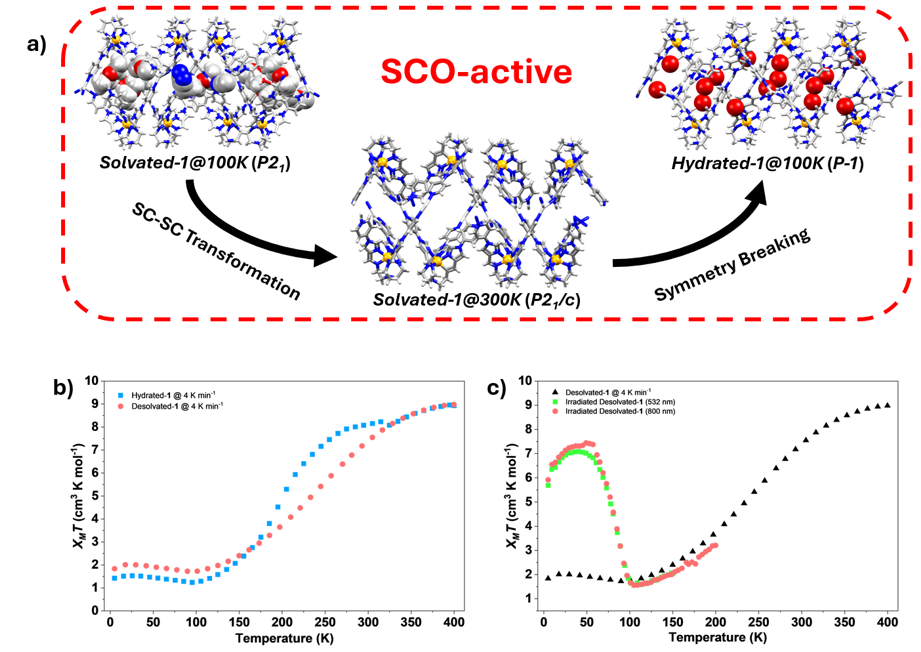
Figure 1. (a) Structural phase transitions in the MOF form. Magnetic susceptibility following a (b) temperature stimulus and a (c) LIESST effect.
- H. Min, A. R. Craze, M. J. Wallis, R. Tokunaga, T. Taira, Y. Hirai, M. M. Bhadbhade, D. J. Fanna, C. E. Marjo, S. Hayami, L. F. Lindoy and F. Li, Chem. Eur. J., 2023, 29, e202203742.
- J. P. Flood, K. Miyake, D. J. Fanna, S. Hayami, L. F. Lindoy, R. A. Shalliker and F. Li, ChemRxiv, 2026, DOI: 10.26434/chemrxiv.15001642/v1.
- The authors would like to thank the Advanced Materials Characterisation Facility (Western Sydney University) and the Solid-State and Elemental Analysis Unit (SSEAU) at the Mark Wainwright Analytical Facility (University of New South Wales) for their expertise and provision of resources and instruments to conduct this research. The authors would also like to thank the staff at the MX1 and MX2 beamlines of the Australian Synchrotron for their crystallographic expertise and travel support.