Poster Presentation Crystal36-AXAA Conference 2026
Advancing the capture of perfluoroalkyl substances using metal organic cages (143558)
Per- and polyfluoroalkyl substances (PFAS) are persistent and ubiquitous pollutants known to have significant negative health impacts.1 Short-chain PFAS are those with a carbon backbone <6, which have better water solubility and less well-defined health effects compared to long-chain analogues.2,3 Their capture and removal from water is a critical area of research. This research explores the host-guest chemistry of a symmetrical Pd6L4 MOC, for which L = 1,3,5-tri(pyridin-4-yl)benzene and Pd = (ethylenediamine)palladium(II) nitrate, as a model “pore” for PFAS capture. PFAS binding within this MOC was interrogated by 1H and 19F NMR titrations and ITC experiments. Through this, new information about the host-guest chemistry of PFAS was elucidated, aiming to improve the design of materials for their capture. In particular, we observed a shift in the host-guest stoichiometry in the presence of excess PFAS relative to the MOC, which was manifested by a new set of proton resonances and a slower diffusion as determined by DOSY. This contrasts with our recent study which investigated similar binding phenomena in a Pd6L4 MOC where L = 2,4,6-tris(4-pyridyl)-1,3,5-triazine – Figure 1 – but did not show evidence of host-guest stoichiometry shifts.4 In ongoing related work, this project aims to prepare Co(III) analogues of these MOCs to create a more affordable system for large-scale use.
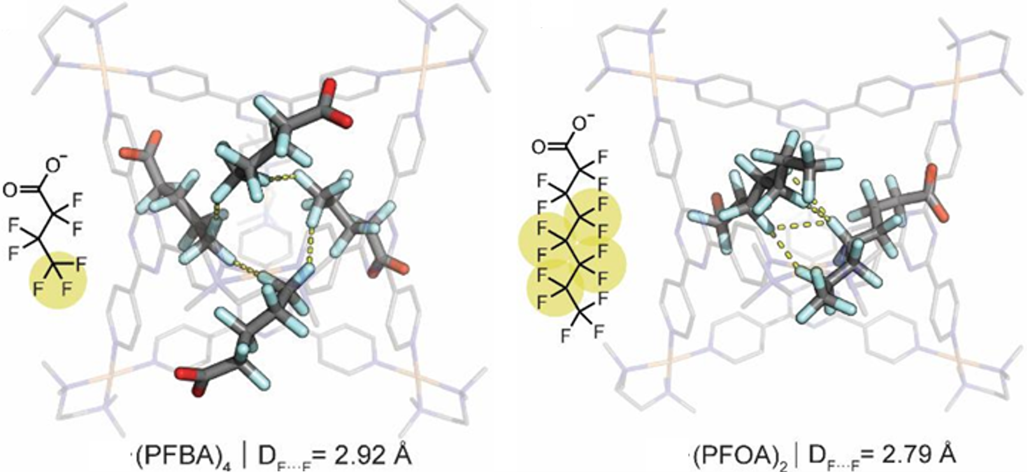
Figure 1: Crystal structures demonstrating the nature of PFAS capture within the Fujita Cage.
- Wee, S. Y.; Aris, A. Z. Environmental Impacts, Exposure Pathways, and Health Effects of PFOA and PFOS. Ecotoxicol. Environ. Saf. 2023, 267. https://doi.org/10.1016/j.ecoenv.2023.115663.
- Wang, Y.; Liu, M.; Vo Duy, S.; Munoz, G.; Sauvé, S.; Liu, J. Fast Analysis of Short-Chain and Ultra-Short-Chain Fluorinated Organics in Water by on-Line Extraction Coupled to HPLC-HRMS. Sci. Total Environ. 2024, 943. https://doi.org/10.1016/j.scitotenv.2024.173682.
- Zheng, G.; Eick, S. M.; Salamova, A. Elevated Levels of Ultrashort- and Short-Chain Perfluoroalkyl Acids in US Homes and People. Environ. Sci. Technol. 2023, 57 (42), 15782–15793. https://doi.org/10.1021/acs.est.2c06715.
- Andersson, C. V. I.; Mudiyanselage, S. G. T.; Mann, M.; Chalker, J. M.; Coote, M. L.; Johnston, M. R. Efficient Removal of Short-Chain Perfluoroalkyl Substances by Cavity-Directed Aggregation in a Molecular Cage Host. 2026, 138 (12), 1–10. https://doi.org/10.1002/ange.202526027.