Oral Presentation Crystal36-AXAA Conference 2026
Characterising plastic defects in a glass using Burger's vector measurements from small-beam diffraction. (143578)
Small-beam diffraction measurements such as micro-small angle x-ray scattering (μSAXS – [1]) and electron nanodiffraction (END – [2]) are a promising methodology to probe local structure in glasses ranging from colloidal assemblies made to metallic glasses. Of particular interest are spatially-resolved measurements of local angular symmetries and strain (dilation/contraction and anisotropy) in nearest-neighbour configurations to examine local, particle-level, structural transformations during deformation [1].
Crystals possess periodic long-range order. Plasticity in crystals is mediated by the creation and propagation of well-defined topological defects that are discontinuities in this order. As shown in Figure 1 (A) these dislocations can be readily identified and characterised using the Burger's vector. The Burger's vector is calculated using a closed line integral around the defect that integrates increments in the particle displacement field. Via a change in variable, the Burger's vector can also be calculated from the local strains or distortions. A non-zero Burger's vector corresponds to a region where the strain is incompatible with a single-valued displacement field, such as at a dislocation core [3]. This procedure implicitly assumes that the reference structure is a perfect crystal and so any displacements from this perfect reference in the final structure are due to plastic re-arrangements. Glasses have a disordered structure that lacks long range periodicity. Glasses also undergo local and co-ordinated deformation-induced structural re-arrangements, as shown in Figure 1 (B - C), but the nature of these is not well understood, and there is no standard method to experimentally characterise plastic "defects" in glasses.
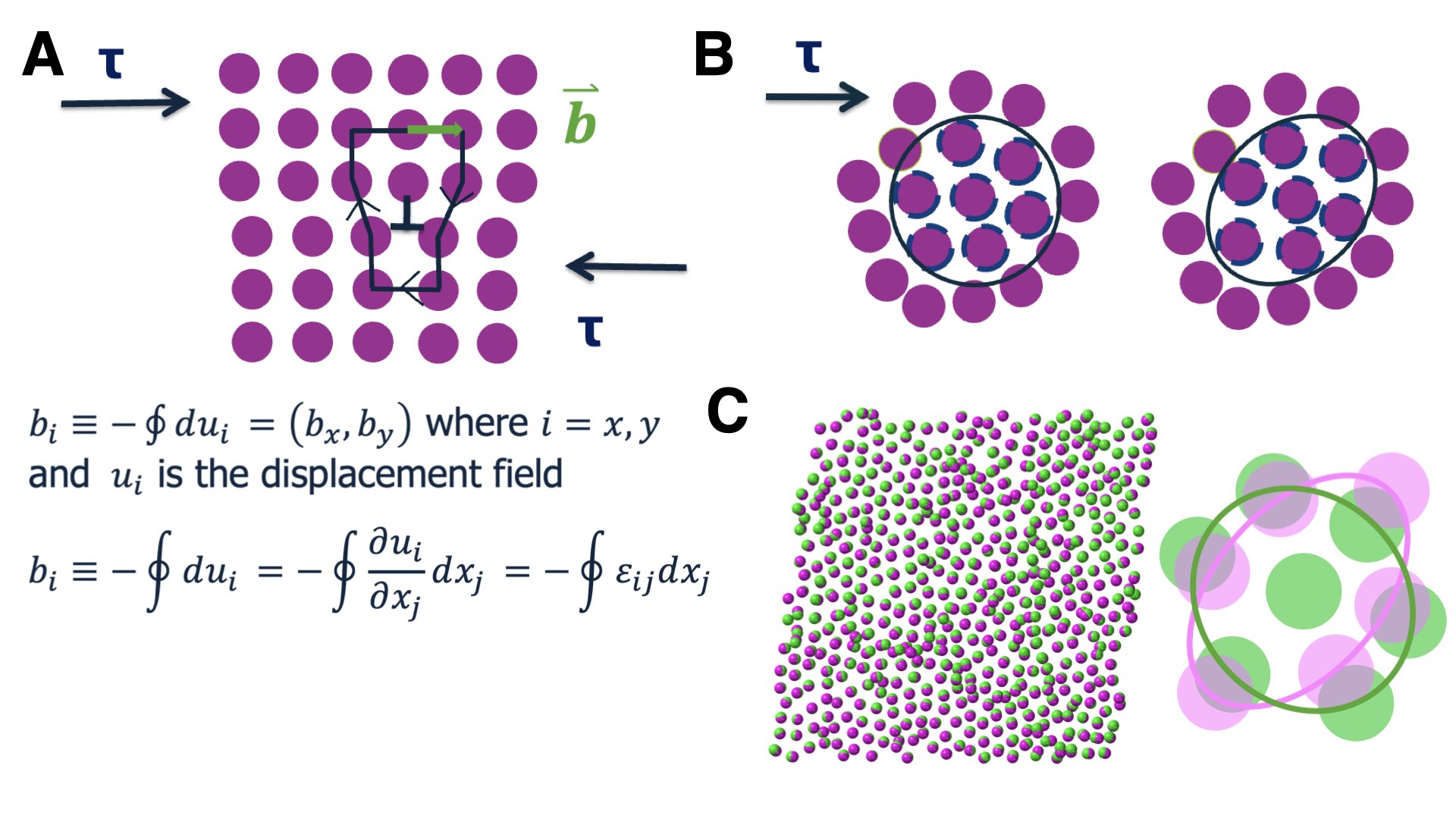
Figure 1: (A) Burger's vector to characterise a dislocation in a crystal (B) Deformation-induced structural transformations in a glass (C) Co-ordinated local structural transformations in a simulated glass under simple shear
Periodicity is not a requirement to calculate the Burger's vector and in general this quantity can be calculated from the particle displacement or local plastic strain fields [4]. The information from the Burger's vector in a glass is rich as shown in Figure 2 (A-C). Here we see that the Burger's vector (B) calculated from the displacement field in (A) contains detailed information about co-ordinated slip in glasses at the length scale of a polyhedral radius (C). For glasses, the reference structure is not known and so the displacements and plastic strain can't be intuited from the final configuration alone, making experimental measurements challenging. Recently, we demonstrated a way around this issue [5], by taking local strain field measurements with scanning small-beam diffraction both before and after the deformation induced structural re-arrangements and calculating the local plastic strain field from the difference. We present a μSAXS measurement of colloidal glasses that demonstrates the potential of this approach for characterising plastic "defects" in glasses [5] and understanding their mechanical properties.
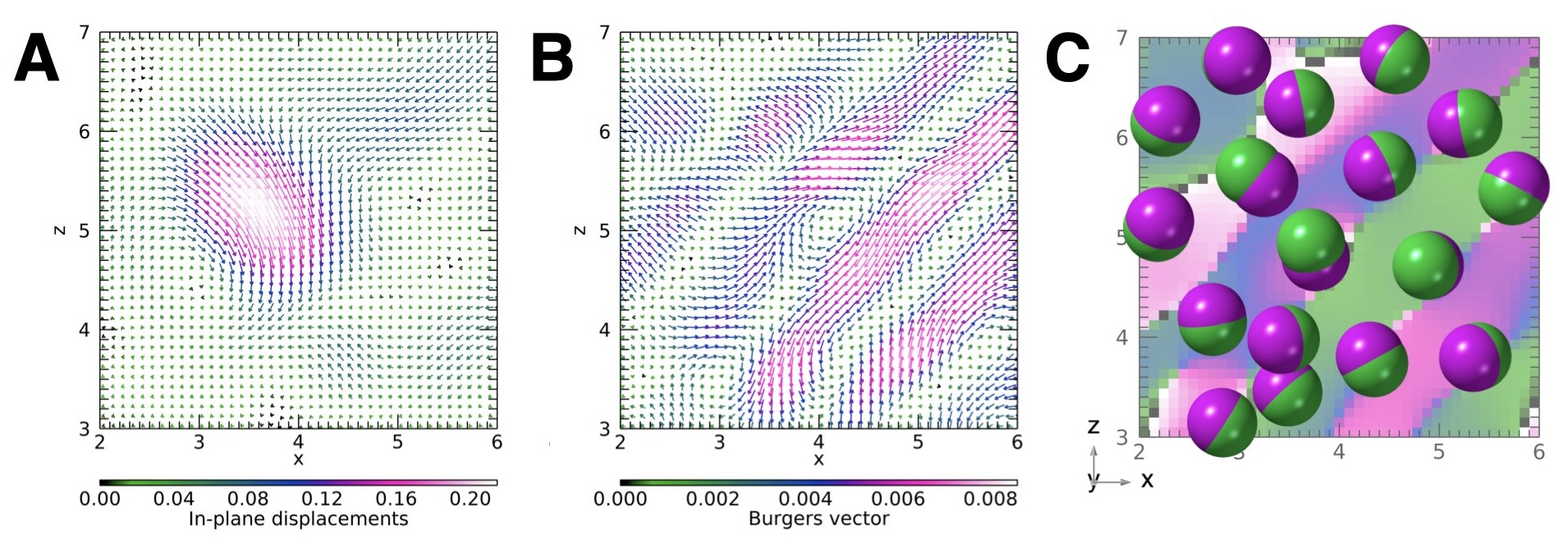
Figure 2: (A) Displacement field in a glass (B) corresponding Burger's vector (C) particle displacements (green to pink) overlaid on Burger's direction
- ACY Liu, ED Bøjesen, RF Tabor, ST Mudie, A Zaccone, P Harrowell, and TC Petersen, Sci. Adv. 8, eabn0681, (2022)
- ACY Liu, MJ Neish, G Stokol, GA Buckley, LA Smillie, MD de Jonge, RT Ott, MJ Kramer, L and Bourgeois, Phys. Rev. Lett. 110, 205505, (2013)
- H Kleinert, ”Gauge Fields in Condensed Matter. Vol. II Stresses and Defects” World Scientific, Singapore, New Jersey, London, Hong Kong, (1989)
- M Baggioli, I Kriuchevskyi, TW Sirk, and A Zaccone, Phys. Rev. Lett. 127, 015501, (2021)
- ACY Liu, H Pham, A Bera, TC Petersen, TW Sirk, ST Mudie, RF Tabor, J Nunez-Iglesias, A Zaccone, and M Baggioli, Acta Cryst. A82, 4-17,(2026)
- Acknowledgements I acknowledge support from the Australian Research Council (DP250102966, FT180100594) and the use of the instruments ((LE0882821) and scientific and technical assistance at the Monash Centre for Electron Microscopy (MCEM), a Node of Microscopy Australia. Part of this research was undertaken on the SAXS/WAXS beamline at the Australian Synchrotron, part of ANSTO.