Poster Presentation Crystal36-AXAA Conference 2026
In situ XRD study of thermochemical formation of sodium borohydride (143645)
Sodium borohydride (NaBH4) is a hydrogen export material (solid powder) which releases hydrogen in contact with water (hydrolysis) or an alcohol such as methanol (methanolysis). The regeneration of this material from mechanochemical and thermochemical processes from its hydrolysis by-product NaBO2 using metal or metal hydride reductants is well known but typically requires high temperatures (450-650 °C). An alternative regeneration route has been considered using the methanolysis by-product NaB(OCH3)4. In situ synchrotron X-ray diffraction (SXRD) was used to detect the formation of NaBH4 from both NaBO2 and NaB(OCH3)4 using various metal hydride reducing agents (NaH, MgH2, Mg2FeH6, LiAlH4, NaAlH4, CaNi5Hx, and LaNi5Hx). A capillary gas cell held powder samples that were thermally ramped under 20 bar hydrogen pressure to assess the reaction pathways. NaBH4 formation was detected using in situ SXRD, demonstrating the optimal temperature windows for regeneration and resulting products at different temperatures (Fig. 1). It was determined that NaBH4 can be recycled from NaB(OCH3)4 using lower temperatures than from NaBO2 and presents an alternative regeneration route that could offer cost and energy savings.
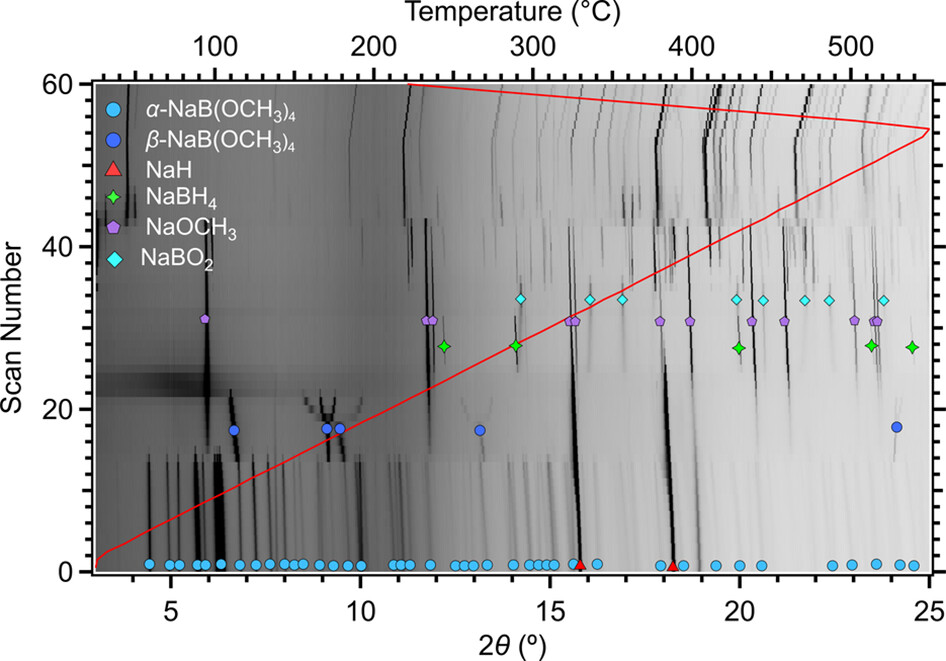
Figure 1. Ball milled sample of NaB(OCH3)4 and 4NaH undergoing in situ synchrotron X-ray diffraction under 20 bar hydrogen gas, with a temperature ramp rate of 8 °C/min to 500 °C (λ = 0.77490(1) Å).1
- Ibrahim A, Paskevicius M, Patel A, D’Angelo AM, Humphries TD, Buckley CE. Thermochemical formation of sodium borohydride from sodium tetramethoxyborate. 2024;7(23):11206-11217. doi:10.1021/acsaem.4c02514.