Oral Presentation Crystal36-AXAA Conference 2026
Electron crystallography for inorganic materials discovery (142871)
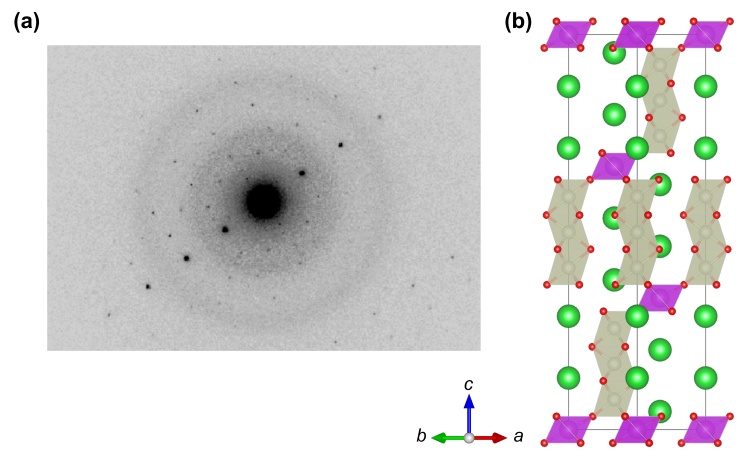
Recent advances in 3D microcrystal electron diffraction (microED, also known as 3DED) techniques have advanced this field of crystallography from largely qualitative unit cell and space-group determination to direct structure solution and quantitative refinement of small molecules, ionic materials, and even proteins (1, 2). The ability to collect data from sub-micron sized crystals (too small for even synchrotron X-rays) means that essentially any sample consisting of crystallites large enough to produce a powder diffraction pattern can be analysed as single crystals.
In late 2025, we installed a Rigaku Synergy-ED at The University of Sydney, the first dedicated high-throughput microED facility in the southern hemisphere. Here we will focus on its applications in inorganic solid-state materials chemistry, a field in which growing large crystals is challenging due to the predominance of sub-solidus reaction pathways. MicroED is proving to be a revelation for materials discovery, where samples routinely consist of multiple unknown phases that are challenging to separate, let alone solve the structures of, using powder diffraction. We will present the microED workflows we are developing and showcase a variety of new metal oxide structures that we discovered with them in the last 6 months alone.
- Gemmi M, Mugnaioli E, Gorelik TE, Kolb U, Palatinus L, Boullay P, et al. 3D Electron Diffraction: The Nanocrystallography Revolution. ACS Central Science. 2019;5(8):1315–29.
- Saha A, Nia SS, Rodríguez JA. Electron Diffraction of 3D Molecular Crystals. Chemical Reviews. 2022;122(17):13883–914.