Oral Presentation Crystal36-AXAA Conference 2026
Partial magnetic order in the face-sharing Mn₃O₁₂ trimer family Ba₄MMn₃O₁₂ (143373)
High-performance magnets are dominated by rare-earth (RE) compounds, despite environmental and economic costs. Developing sustainable alternatives is urgent, and our work targets transition metal (TM)–based systems. The Ba₄MMn₃O₁₂ family (M = TM or RE [1-6]) crystallizes in R-3m symmetry with face-sharing M₃O₁₂ trimers that host competing ferro- and antiferromagnetic interactions, leading to unusual properties. Prior studies reported low-temperature magnetic transitions [4,5,6], but the microscopic magnetic ordering remains unclear. We synthesized Ba₄MMn₃O₁₂ (M = Nb, Ta, Sb) and reproduced bulk magnetization confirming low-temperature magnetic ordering. The measured effective magnetic moments are smaller than expected for mixed oxidation state Mn+4 and Mn+3 ions, implying strong inter-trimer coupling and cluster formation. This points to the system not being fully paramagnetic at room temperature, but in an intermediate state of disordered magnetic clusters [7] (ideally with a cluster moment of S=2). To resolve the local structure, we employed neutron powder diffraction, revealing long-range antiferromagnetic order for M = Nb and Ta, propagation vector = (3/2, 0, 0) and magnetic space group PA2₁/c, with small refined atomic magnetic moments for both Mn ions. Strikingly, neutron data also reveals site disordering, with Mn+4 jumping into the Nb sites. These disordered Mn atoms appear, in the case of Ta samples, non-magnetic, consistent with exotic “idle spin” states seen in other frustrated systems. To account for the lack of atomic moment, diffuse neutron scattering experiments have been carried out, confirming the existence of partial disordering. This data can resolve the proportion of ordered and disordered atomic magnetic moment at each site, giving us a definitive value of the cluster magnetic moment. We will present combined Rietveld refinement, powder neutron diffraction and diffuse scattering analysis to establish a comprehensive picture of magnetism in this family.
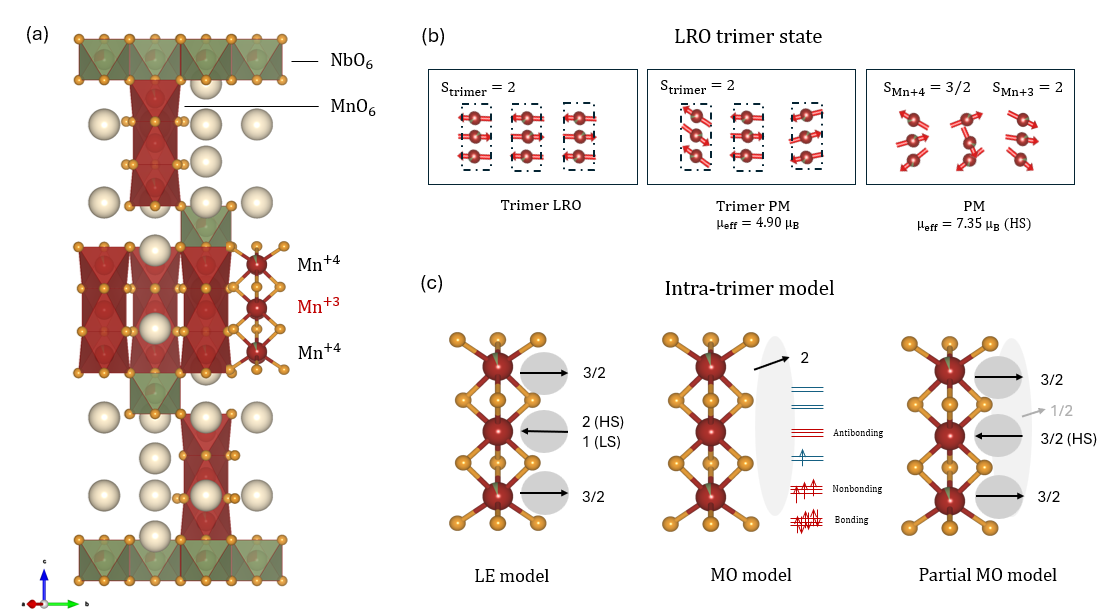
Figure 1. (a) Nuclear structure of Ba4MMn3O12 with M = Nb, Ta, Sb, space group R-3m (No. 166). Ba, Nb, Mn and O atoms are presented as beige, green, red and yellow spheres respectively. The polyhedra of one trimer have been removed for better visualisation. (b) Interpretation of published bulk magnetometry results assuming trimers of S = 2. On the left, trimers are formed and LRO is a mix of FM and AFM. Increasing temperature erases inter-trimer LRO, giving a PM system of locally magnetic trimers. Ultimately the intra-trimer order is also lost, leaving a fully PM state. (c) Diagram for intra-trimer systems resulting in S = 2 trimers.
- [1] Fuentes, A. & Boulahya, K. & Amador, U. (2004). Journal of Solid-State Chemistry. 177. 714-720
- [2] Wu, J., et al. (2021). RSC Adv 11(63): 40235-40242
- [3] Nguyen, L. T., et al. (2018). Physical Review Materials 2(5)
- [4] Nguyen, L. T., Kong, T., & Cava, R. J. (2019). Materials Research Express, 6(5), 056108
- [5] Ali, A., et al. (2024). Physical Review Research, 2024, 6(1)
- [6] Yan, X., et al. (2023). RSC Adv 13(17): 11234-11240.
- [7] Komleva, E. V., et al. (2020). Physical Review B 102(17)