Oral Presentation Crystal36-AXAA Conference 2026
Structure determination of new ionic conductors from complex mixtures (143460)
While combinatorial synthesis coupled to theoretical calculations is gaining more and more attention for the discovery of new materials, it remains a challenge to determine the crystal structure of new materials from mixtures. In the last decade, despite that many efforts have been dedicated to the combinatorial synthesis and the characterization of the obtained phases, it usually concentrates on single phase materials [1]. Single phase materials are obtained usually when the phase diagram is known, which is usually not the case when exploring new systems. At the exception of serial rotation electron diffraction [2], typically the structure determination of new phases remains unanswered when dealing with complex mixtures. This challenge was addressed recently using a full software solution from phase identification to pattern deconvolution and Rietveld refinement [3].
In this contribution taking advantage of those developments, we are reporting on the exploration of the system Li/Na-Sn-P-O. We could solve the crystal structures of 2 new candidates for ionic conductors obtained from phase mixtures (as illustrated in Figure 1a), namely A2Sn(PO4)2 (A = Li, Na) from 5 min laboratory X-ray scan data. Both materials exhibit a new structural type within the A2M(PO4)2 series (A= Alkali ion, M = Zr, Ti, Sn). The crystal structure accuracy was further confirmed by DFT calculations. Investigation of the ion conduction pathways from bond valence suggests that those materials are good candidates for ionic conduction (see Figure 1b). The ability to combine phase identification and to disentangle the various contributions from a phase mixture for structure solution opens the possibility to fully exploit the capabilities of combinatorial chemistry using laboratory powder diffraction. 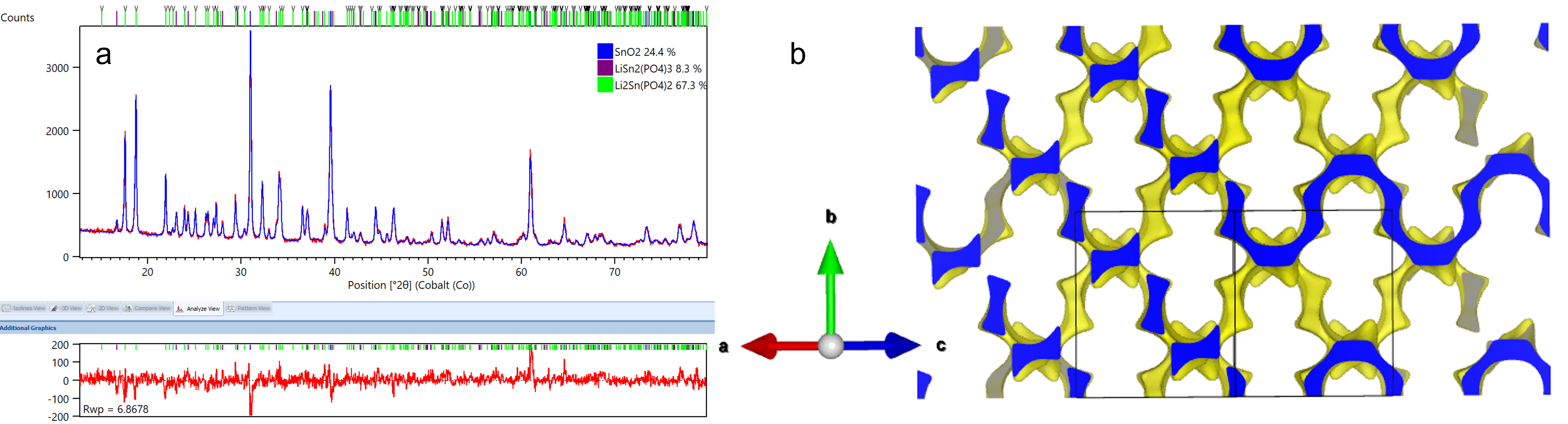
Figure 1. a) Rietveld refinement of the phase mixture containing the new phase Li2Sn(PO4)2 and b) the corresponding bond-valence Energy landscape map illustrating conduction path along the [111].
- [1] N. J. Szymanski, et al. Nature, (2023) 624, 86
- [2] Y. Luo, B. Wang, S. Smeets, J. Sun, W. Yang, X. Zou, Nature Chemistry (2023) 15, 483
- [3] G. Nénert, Powder Diffraction (2023) 38, 180