Poster Presentation Crystal36-AXAA Conference 2026
Capture of metal-halides within Pt(II) coordination cages (145165)
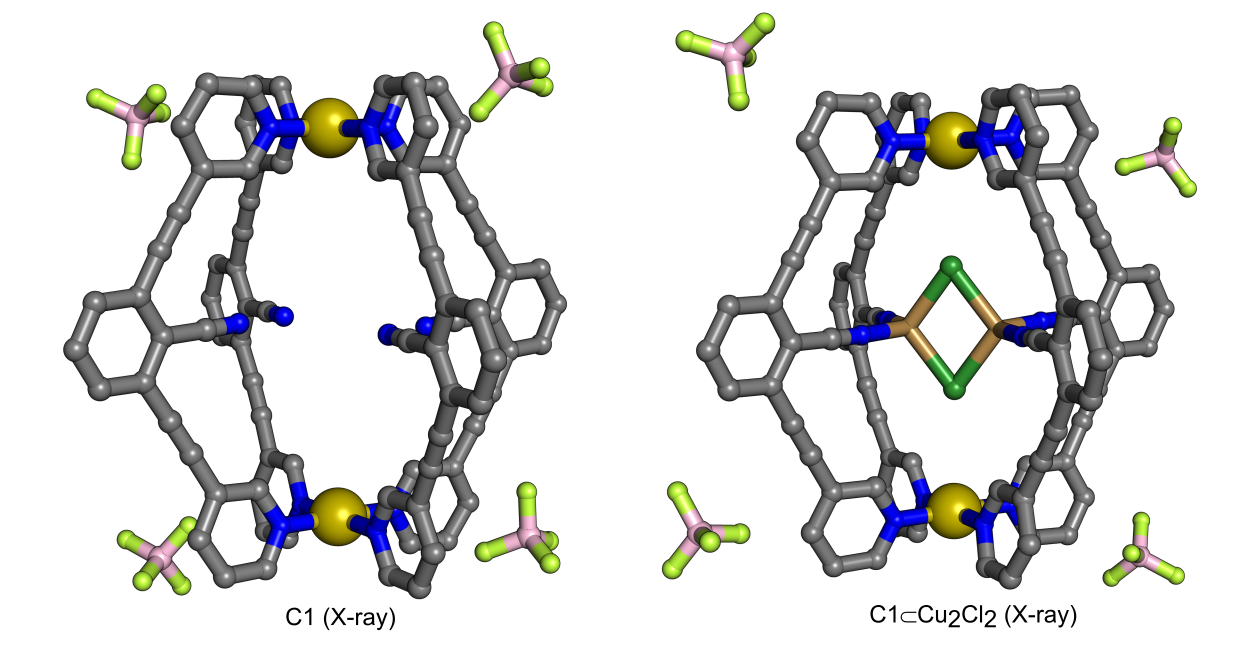
Coordination cages are self-assembled structures with application in areas including catalysis,[1] drug delivery,[2] and sensing. [3,4] One intriguing area is the capture and stabilisation of reactive metal ions, whereby their reactivity can be controlled or switched on/off. The capture of metal ions in solution has been seen in saturated metal ion clathrochelates,[5] metal-ion arrays,[6] and exo-functionalised ligands,[7,8] yet capturing metal-ion pair remains a challenge. In this work, Pt2L4 coordination cages functionalised with endohedral nitrile groups were assembled by combining the ligand 2,6-bis(pyridin-3-ylethynyl)benzonitrile (L1), with Pt(II) in CD3CN at 150 ⁰C under microwave irradiation for 1 hour. The resulting [Pt2L14](BF4)2 structure (C1), characterised by SC-XRD, features a cavity occupied by four non-coordinated nitrile groups. The closest distance DN-N = 3.64 Å results in a negative region of electrostatic potential at their termini, which in turn can act as an electron donor.[10,11] While nitrile ligands are themselves weak modest sigma-donors and generally labile, the nitrile functionalised cage represents a tetradentate “metallosupramolecular ligand”. Post-assembly metalation was achieved by exposing C1 to transition metals (Ag, Co, Fe, Ni), then triggering metalation by subsequent addition of a halide. Mononuclear heterometallic cage complexes with Fe(II) and Ni(II) were achieved, conforming to the principle of charge-balanced encapsulation. By contrast, with Ag(I) or Cu(I) a dinuclear Cu2Cl2 dimer was observed in the cavity of the cage. Interestingly, when incorporated inside the cage, Cu(I) is completely shielded from oxidation. These results highlight the ability to encapsulate metal-halide species in organic solutions, which may be useful for delivery systems or catalysis.
- Y. D. Xue, X. X. Hang, J. W. Ding, B. Li, R. M. Zhu, H. Pang, Q. Xu, “Catalysis within coordination cages” Coord. Chem. Rev. 2021, 430, 213656.
- N. Judge, L. Wang, Y. Y. L. Ho, Y. F. Wang, “Molecular Engineering of Metal-Organic Cycles/Cages for Drug Delivery” Macromol. Res. 2018, 26, 1074–1084.
- M. Rancan, J. Tessarolo, A. Carlotto, S. Carlotto, M. Rando, L. Barchi, E. Bolognesi, R. Seraglia, G. Bottaro, M. Casarin, G. H. Clever, L. Armelao, “Adaptive helicity and chiral recognition in bright europium quadruple-stranded helicates induced by host-guest interaction” Cell Reports Phys. Sci. 2022, 3, 100692.
- A. Brzechwa-Chodzyńska, W. Drożdż, J. Harrowfield, A. R. Stefankiewicz, “Fluorescent sensors: A bright future for cages” Coord. Chem. Rev. 2021, 434, 213820.
- S. M. Jansze, K. Severin, “Clathrochelate Metalloligands in Supramolecular Chemistry and Materials Science” Acc. Chem. Res. 2018, 51, 2139–2147.
- T. Osuga, T. Murase, K. Ono, Y. Yamauchi, M. Fujita, “[m × n] Metal Ion Arrays Templated by Coordination Cages” J. Am. Chem. Soc. 2010, 132, 15553–15555.
- G. Liu, M. Zeller, K. Su, J. Pang, Z. Ju, D. Yuan, M. Hong, “Controlled Orthogonal Self-Assembly of Heterometal-Decorated Coordination Cages” Chem. - A Eur. J. 2016, 22, 17345–17350.
- M. T. Yong, O. M. Linder-Patton, W. M. Bloch, “Assembly of a Heterometallic Cu(II)-Pd(II) Cage by Post-assembly Metal Insertion” Inorg. Chem. 2022, 61, 12863–12869.
- Z. T. Avery, M. G. Gardiner, D. Preston, “Using a New Pt(II) Source to Make Pt(II) Lantern-Shaped Cages, Including Low-Symmetry, Heteroleptic, and Multicavity Examples” Angew. Chemie - Int. Ed. 2025, 64, DOI 10.1002/anie.202418079.
- S. Scheiner, “Versatility of the Cyano Group in Intermolecular Interactions” Molecules 2020, 25, 4495.
- L. Wang, X. Li, Y. Zeng, L. Meng, X. Zhang, “Enhancing effects of π-hole tetrel bonds on the σ-hole interactions in complexes involving F2TO (T = Si, Ge, Sn)” Struct. Chem. 2019, 30, 1301–1313.