Oral Presentation Crystal36-AXAA Conference 2026
Constructing photoactive metal-organic frameworks from a library of tunable donor-acceptor ligands (143371)
Luminescent donor-acceptor species which exhibit thermally activated delayed fluorescence (TADF) are a valuable class of molecules used to assemble high-efficiency OLED devices,[1-3] and as organic photoredox catalysts.[4-6] These molecules are typically assembled from electron-rich N-heterocyclic donors such as carbazole (Cz) or diphenylamine (DPA), and electron-poor acceptors such as 1,3,5-triazine (TAZ), benzonitrile (BN) or tere-, iso- or phthalonitrile (TPN, IPN or PN respectively). The modulator nature of their synthesis allows fine-tuning of the photophysical properties of the luminescent species by judicious selection of donor and acceptor components. Inspired the polycarbazole structure of many TADF materials, and the utility of bis(carbazole dicarboxylate) ligands in the assembly of highly porous metal-organic frameworks,[7-9] we sought to design a library of donor-acceptor polycarboxylate ligands for subsequent assembly into photoactive metal-organic frameworks (MOFs).
We have found that nucleophilic aromatic substitution (SNAr) chemistry between a range of halogenated electron acceptors, and polycarboxylate-functionalised electron donors, is a versatile methodology to synthesise a library of photoactive MOF ligands. Owing to the greater conformational flexibility in triazine-based ligands, the structures of the resultant MOFs are less predictable due to variation in the ligand connectivity and geometry. By contrast, for ligands containing nitrile-based acceptors, the donor and acceptor units are locked in orthogonal orientations due to the greater steric bulk of substituents on the central acceptor unit, so that the connectivity and geometry of these ligands is more predictable. Significantly, for both classes of ligand, upon incorporation into MOFs, we observe retention of the ligand photoluminescence, demonstrating the potential for this strategy to yield a range of photoactive porous materials.
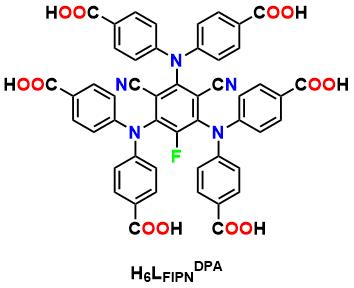
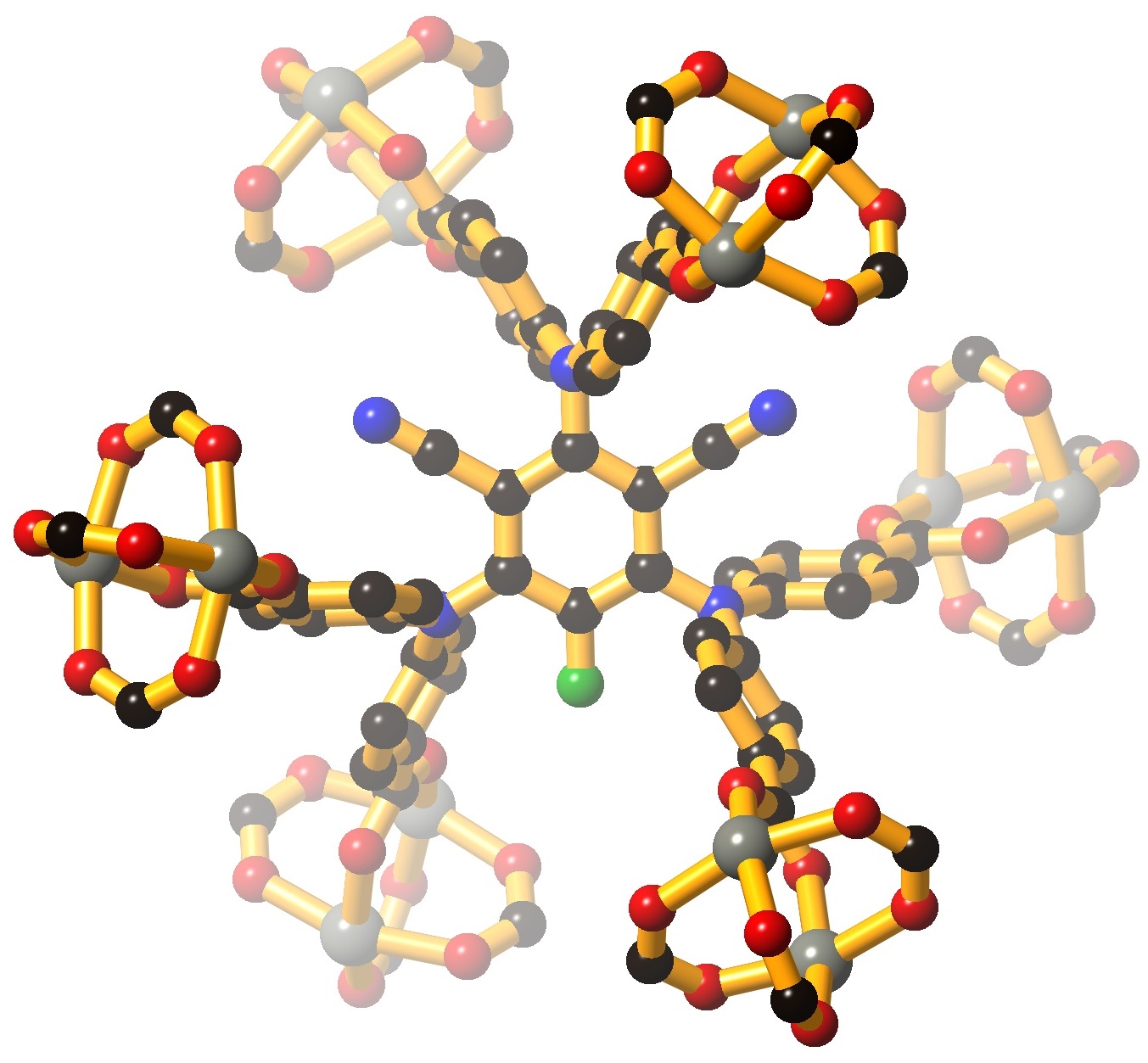
Figure 1: (Left) Chemical structure of the fluoroisophthalonitrile (FIPN)-based donor-acceptor ligand, and (right) crystal structure of the resultant [Zn3(LFIPNDPA)(H2O)3] MOF.
- [1] Uoyama, H.; Goushi, K.; Shizu, K.; Nomura, H.; Adachi, C. Nature 2012, 492 (7428), 234–238.
- [2] Dos Santos, J. M.; Hall, D.; Basumatary, B.; Bryden, M.; Chen, D.; Choudhary, P.; Comerford, T.; Crovini, E.; Danos, A.; De, J.; et al. Chemical Reviews 2024, 124 (24), 13736–14110.
- [3] Sun, D.; Si, C.; Wang, T.; Zysman-Colman, E. Advanced Photonics Research 2022, 3 (11), 2200203.
- [4] Speckmeier, E.; Fischer, T. G.; Zeitler, K. Journal of the American Chemical Society 2018, 140 (45), 15353–15365.
- [5] Garreau, M.; Le Vaillant, F.; Waser, J. Angewandte Chemie International Edition 2019, 58 (24), 8182–8186.
- [6] Ruos, M. E.; Kinney, R. G.; Ring, O. T.; Doyle, A. G. Journal of the American Chemical Society 2023, 145 (33), 18487–18496.
- [7] Krause, S.; Evans, J. D.; Bon, V.; Senkovska, I.; Iacomi, P.; Kolbe, F.; Ehrling, S.; Troschke, E.; Getzschmann, J.; Többens, D. M.; et al. Nature Communications 2019, 10 (1), 3632.
- [8] Stoeck, U.; Krause, S.; Bon, V.; Senkovska, I.; Kaskel, S. Chemical Communications 2012, 48 (88), 10841–10843.
- [9] Garai, B.; Bon, V.; Krause, S.; Schwotzer, F.; Gerlach, M.; Senkovska, I.; Kaskel, S. Chemistry of Materials 2020, 32 (2), 889–896.